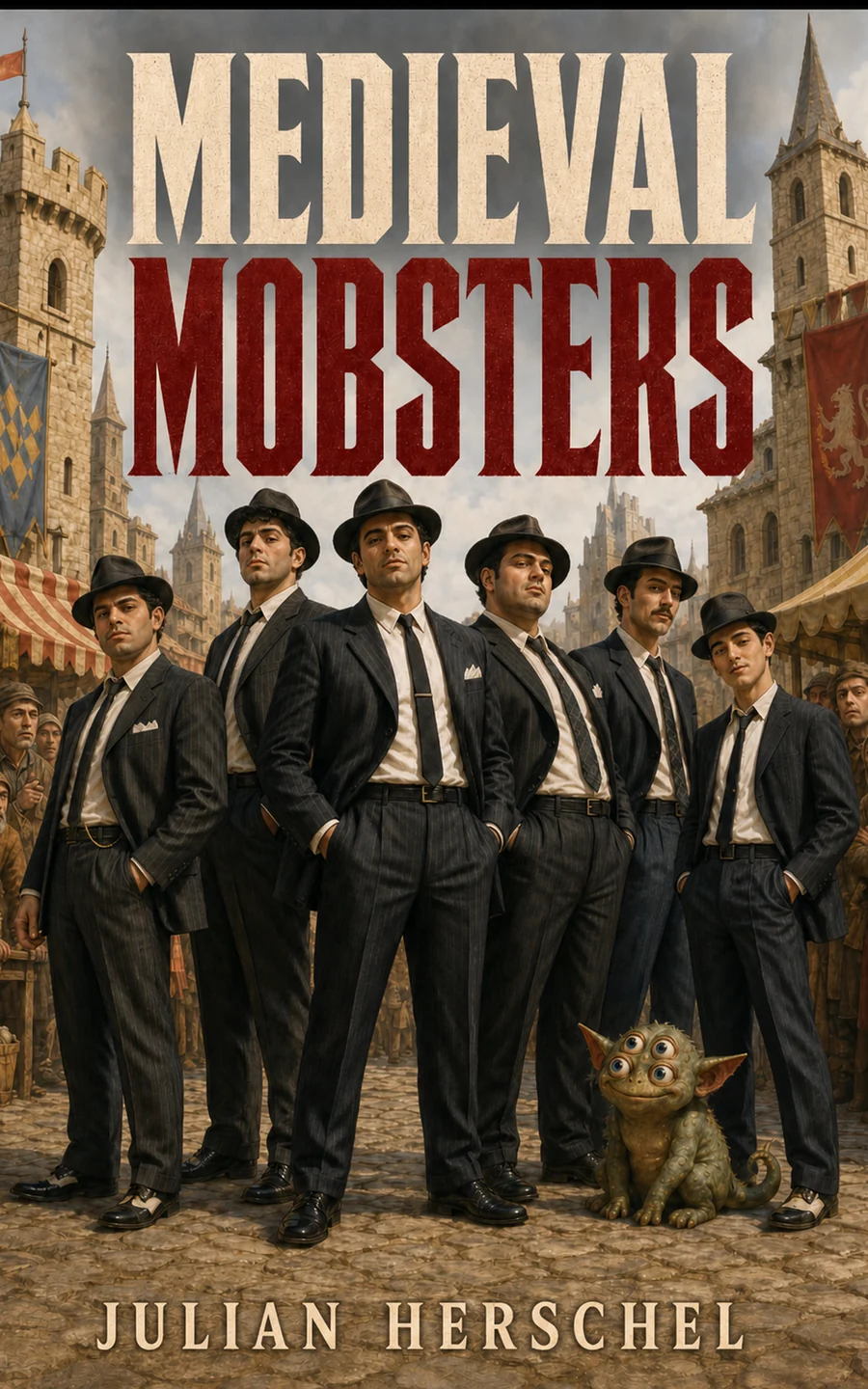
Six wiseguys. One medieval city. Zero questions asked.
Medieval Mobsters
Six wiseguys. One medieval city. Zero questions asked. When six New York mobsters walk out of a Hell's Kitchen basement into a city of knights and guilds, they do not look for a way home. They look for the angles.
Adult comedy. The language is as questionable as the decisions.
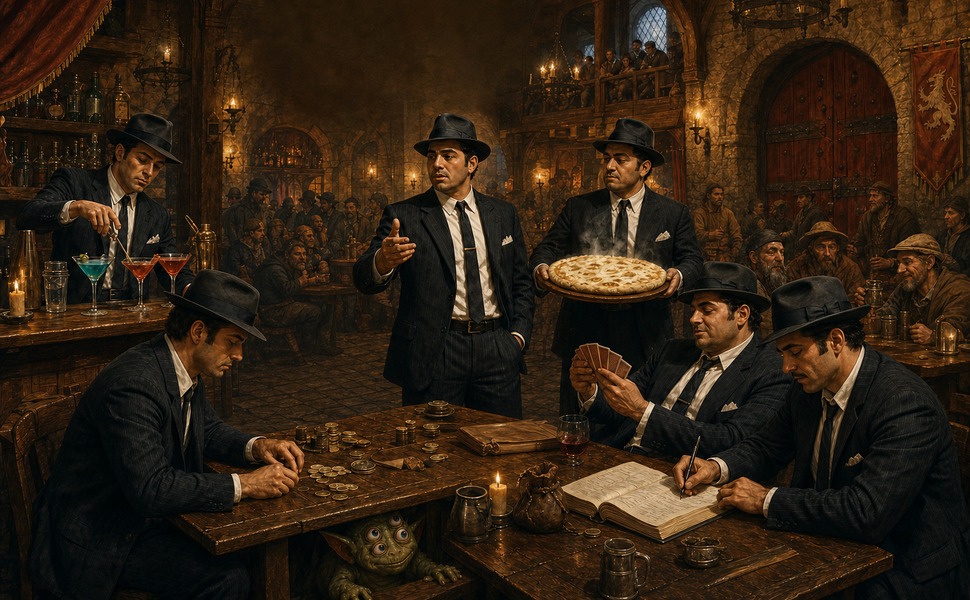
The Thornwall Operations Ledger
They do not look for a way home. They look for the angles.
Six New York wiseguys walk into a medieval city with rumpled suits, twelve precious bullets, and a professional inability to leave an opportunity unorganized. Thornwall has never encountered cocktails, pizza, or customer-friendly protection.

“We walk in like we own it, and eventually, people start believing we do.”
Mikey Morano, strategic planning
Character stories
Meet the crew
They argue constantly, adapt alarmingly fast, and remain fiercely loyal to the only five people who understand how impossible this week has been.
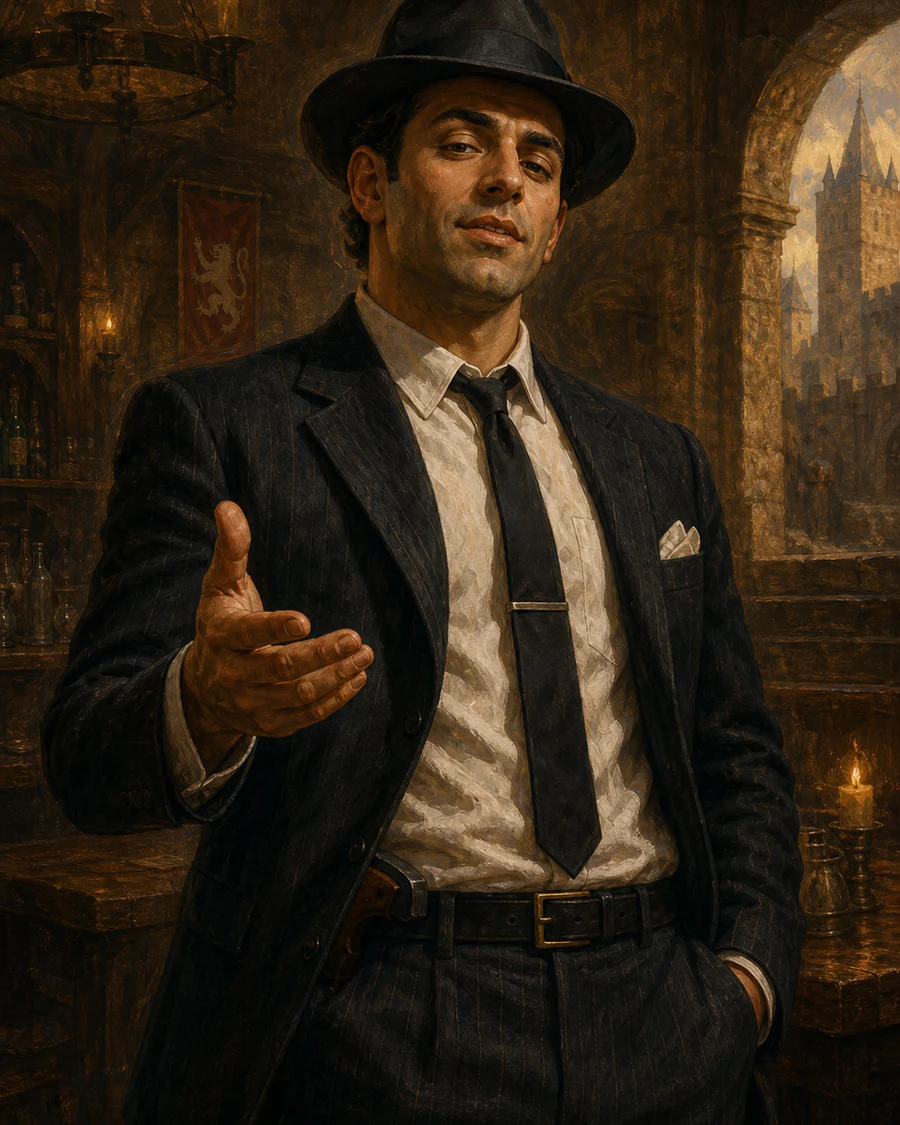
Leader · Nobody Voted
Mikey ‘The Mouth’ Morano
Mikey started talking first and never stopped, which is close enough to leadership for this crew. He pitches the scheme, delegates the work, and cannot admit when medieval vocabulary has defeated him. He has twelve rounds left for his snub-nose revolver; every bullet is now a strategic asset.
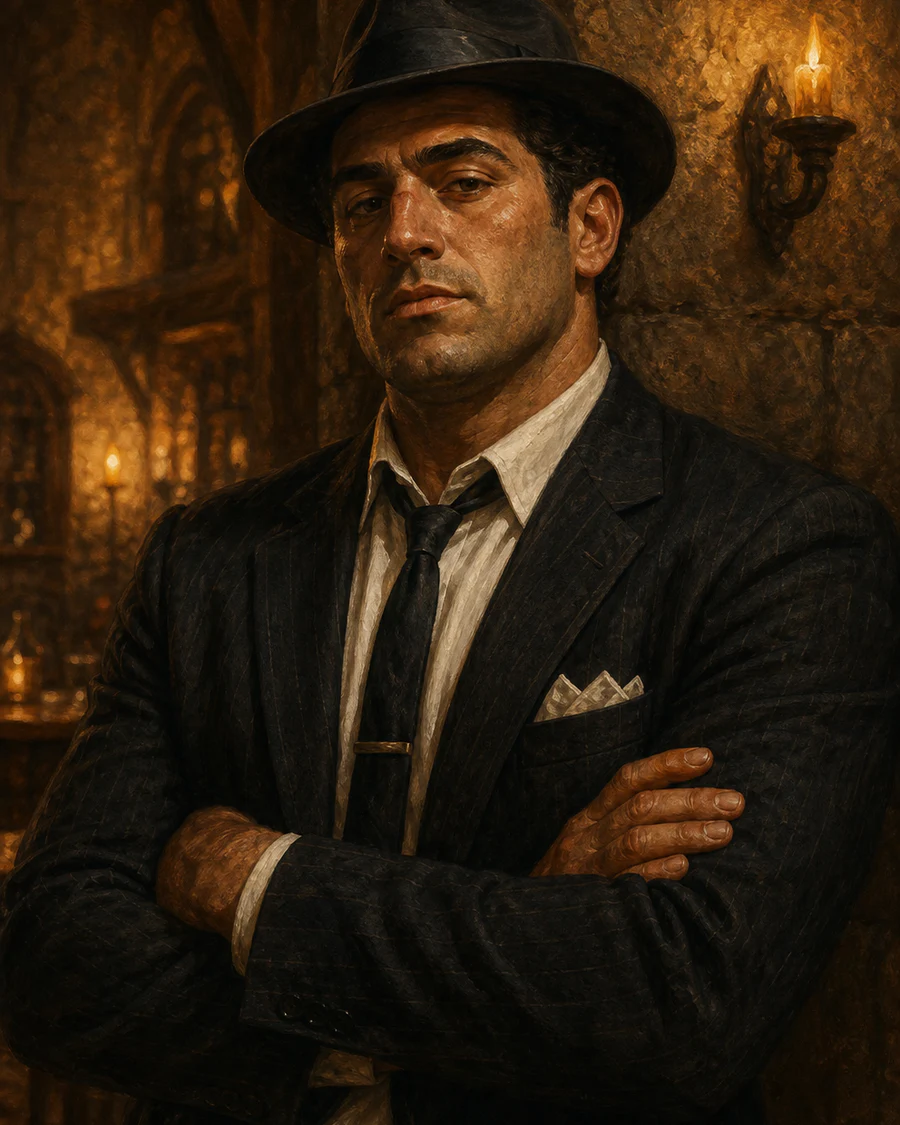
Muscle · Fixer
Sal ‘The Hands’ Salerno
Quiet, practical, and unimpressed by anything supernatural. A dragon is a large bird. A wizard's fireball is a nice trick. Sal understands the local currency before anyone else because he is the only one who stops arguing long enough to buy food.
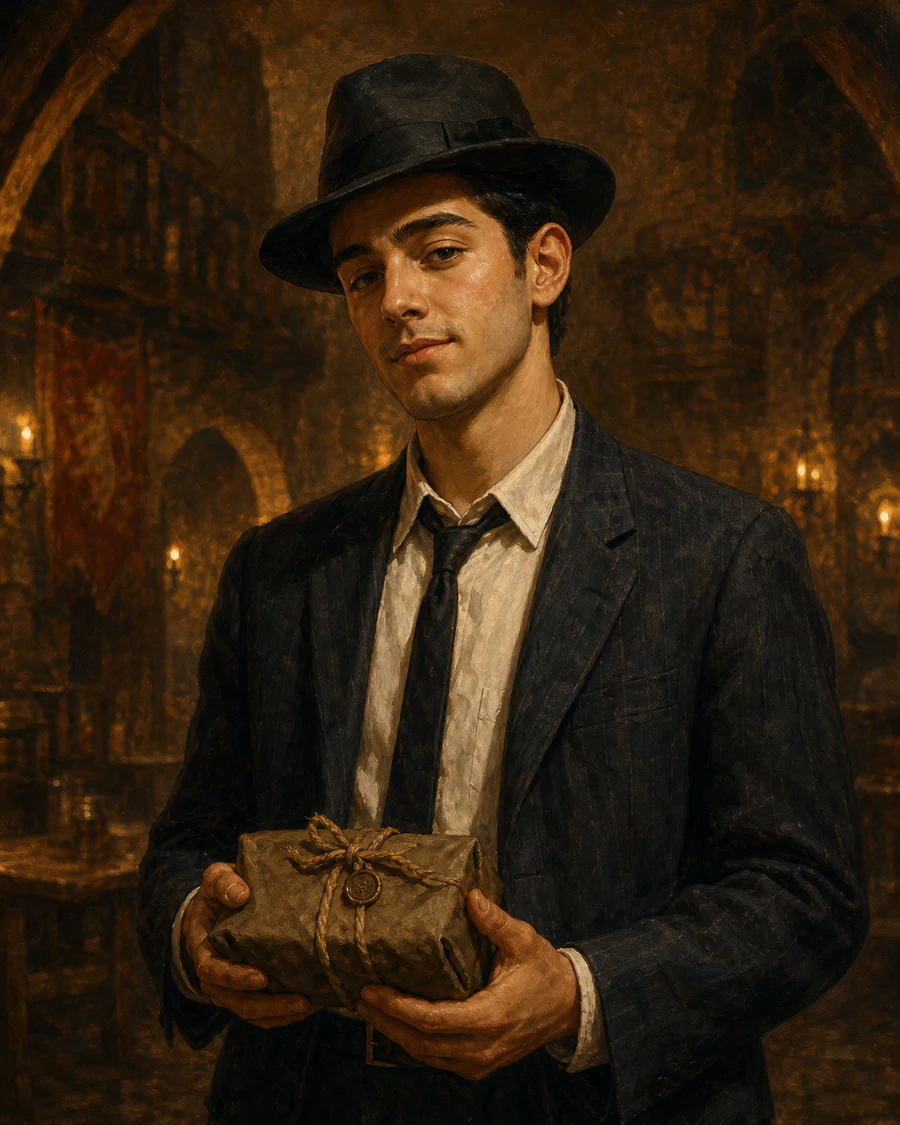
Errand Boy · Accidentally Correct
Tony ‘The Basement’ Castellano
Tony keeps suggesting they check the basement they arrived through. Everyone treats this as proof he is an idiot. Tony remains unconvinced. He would explain why, if anyone would let him finish a sentence.
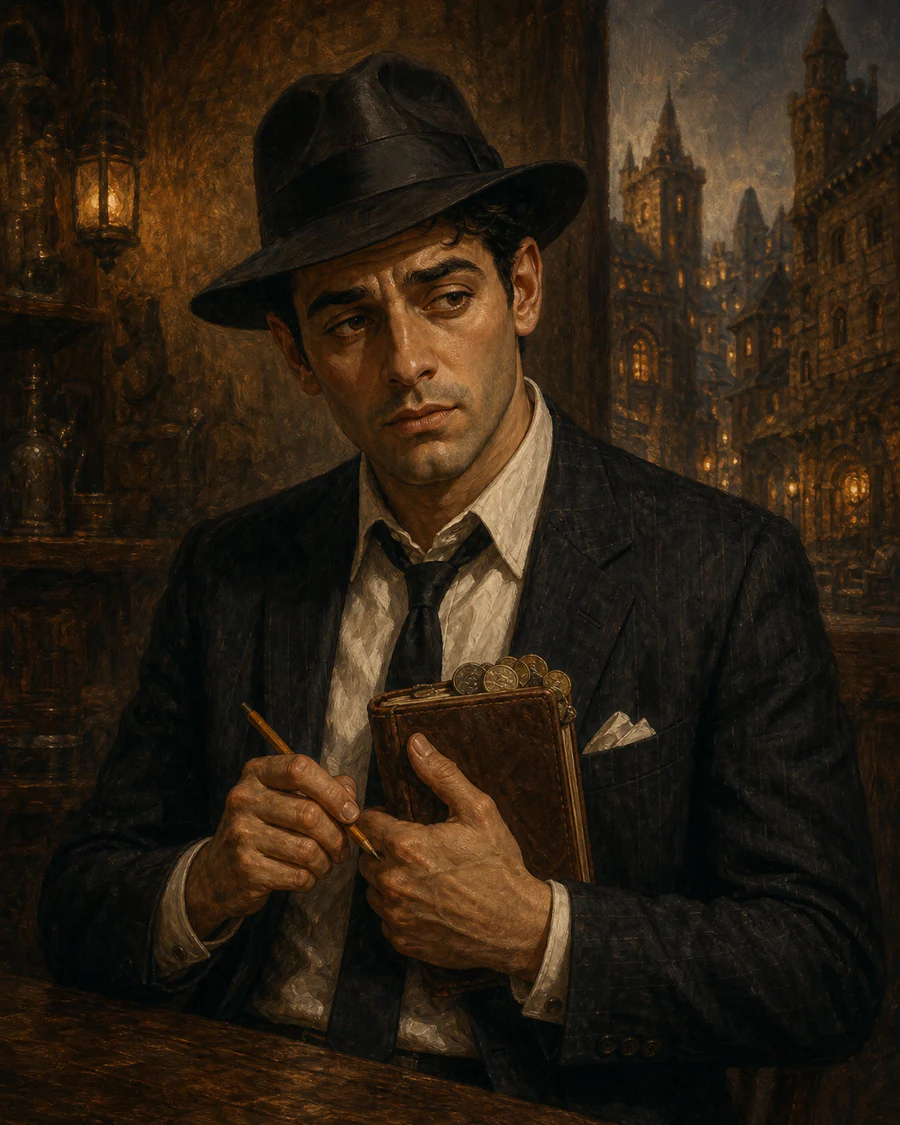
Money · Anxiety
Vinny ‘Books’ Vecchio
Two semesters of college make Vinny the operation's intellectual. He keeps the ledger, deciphers medieval documents, and is developing an exchange rate nobody requested. His pathological cheapness saves the crew exactly as often as it nearly ruins them.
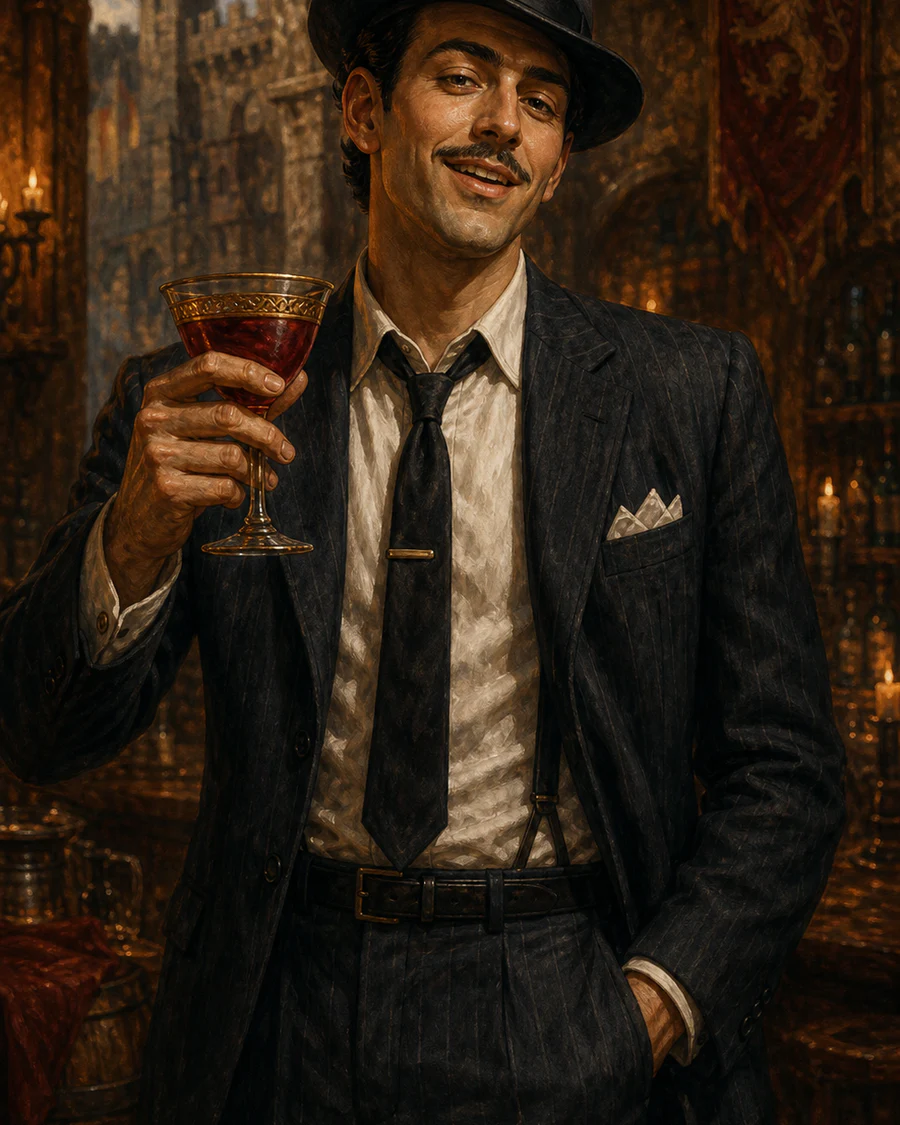
Charm · Cocktails
Paulie ‘Pipes’ Pirelli
Paulie can enter a room of suspicious strangers and have them buying drinks within an hour. He invents the cocktail for a century that thought ale in a bucket was enough. Women, vanity, and his own singing voice remain persistent operational risks.
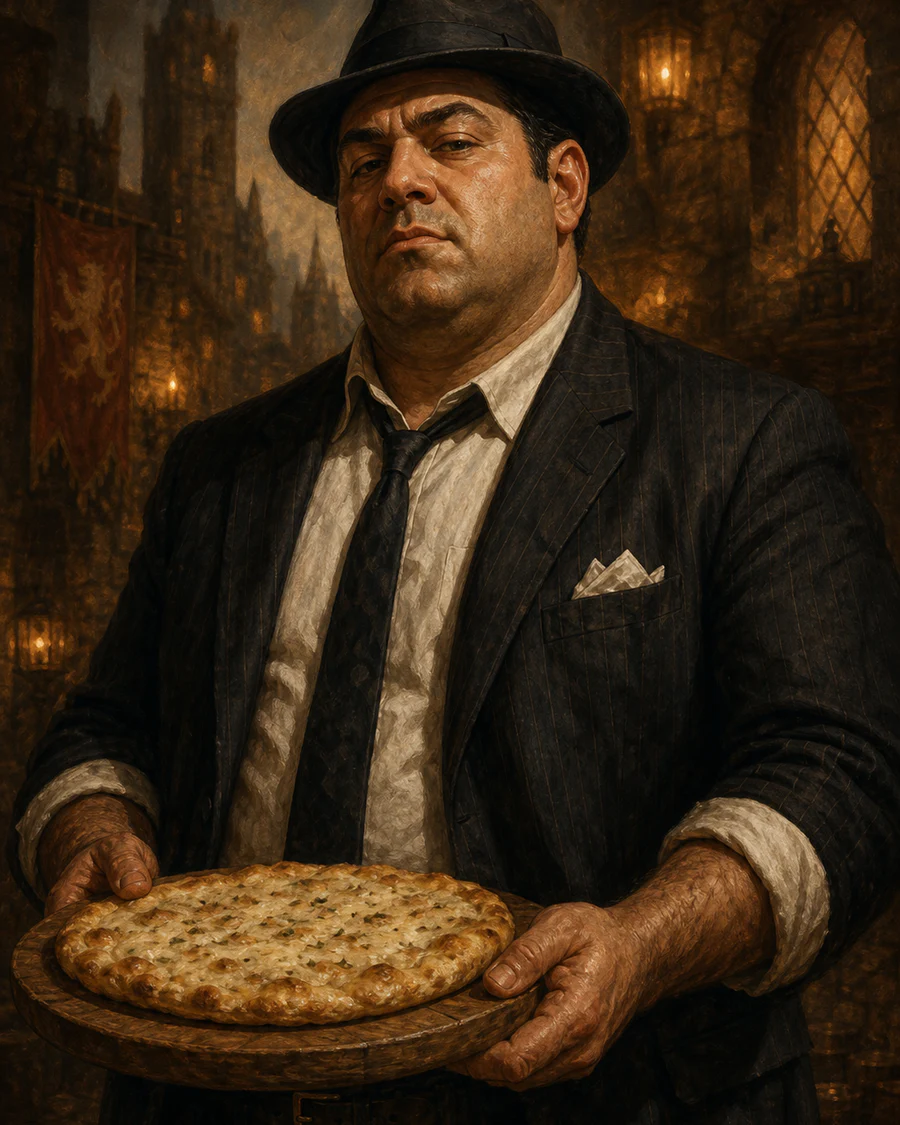
Cook · Culinary Revolutionary
Frankie ‘No Neck’ Nardone
The schemes, rackets, and protection money are all funding for Frankie's real mission: a proper Italian restaurant. Thornwall's ingredients are wrong, its guilds are obstructive, and its cuisine has personally offended him. He will make pizza anyway.
Inside the world
How to build an empire five centuries early
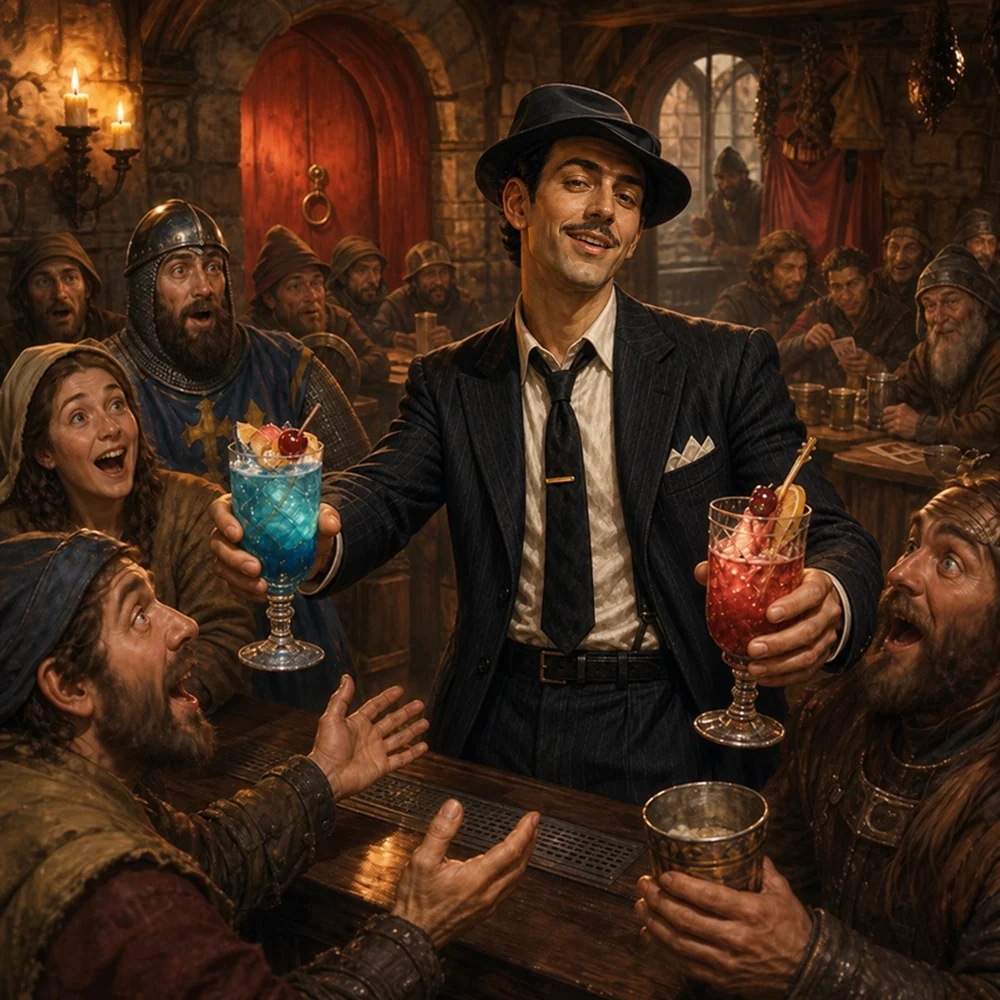
The Red Door
Reinvent the local tavern
Paulie brings cocktails, music, and atmosphere to a city that thought ale in a bucket was sufficient hospitality.

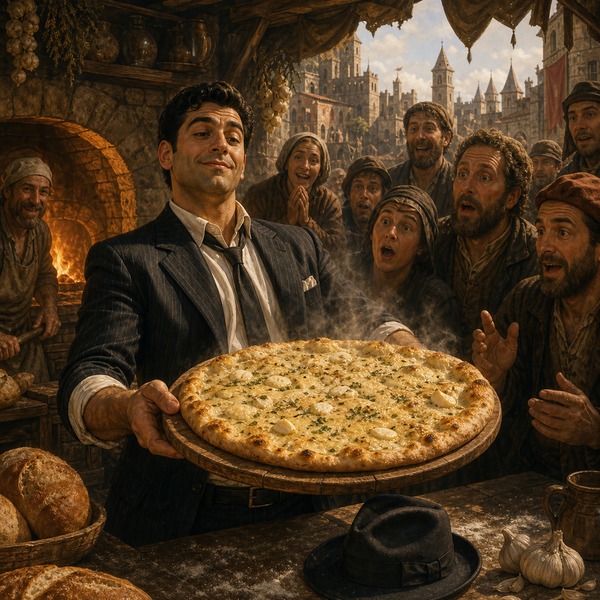
Frankie's Kitchen
Teach a city about pizza
No tomatoes. No familiar ingredients. No excuse. Frankie intends to feed Thornwall whether its Bakers' Guild approves or not.
Read the kitchen memo →
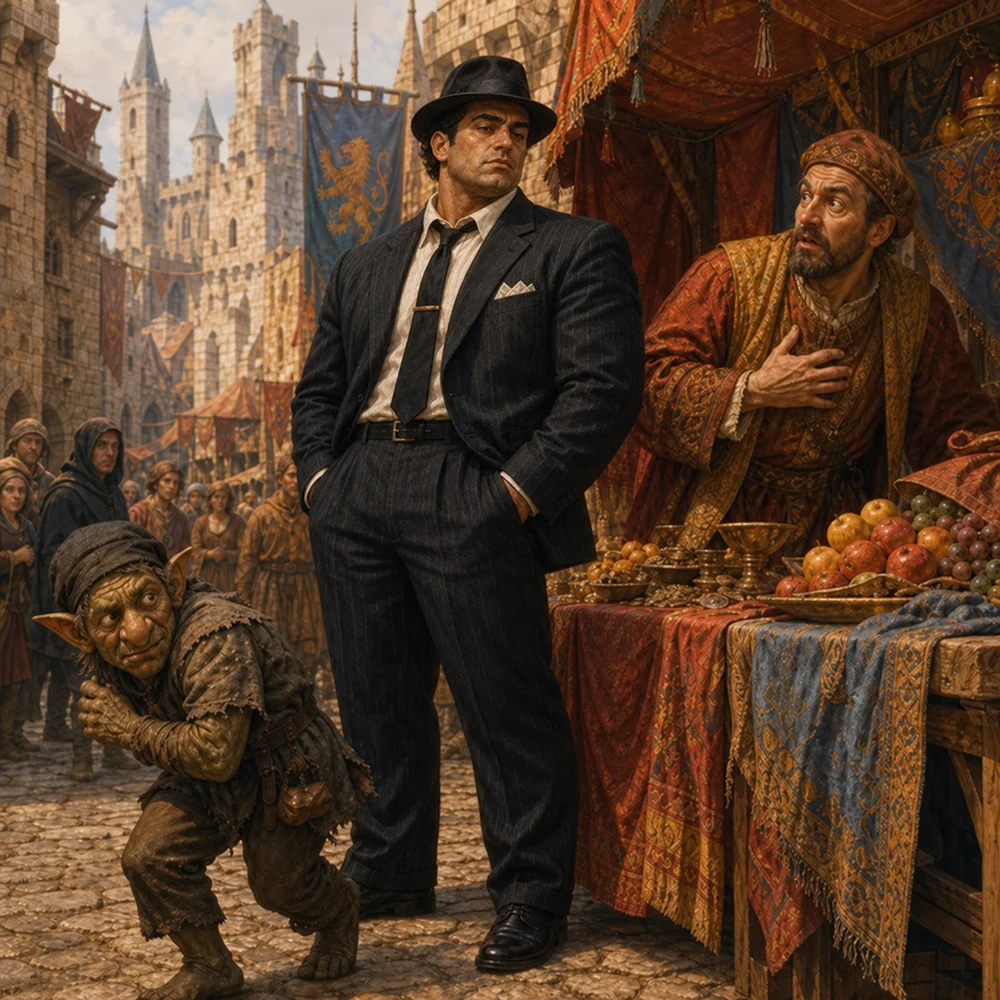
Peace of Mind
Make respect profitable
The merchants pay for peace of mind. Sal provides the peace. The paperwork describes this as a community service.

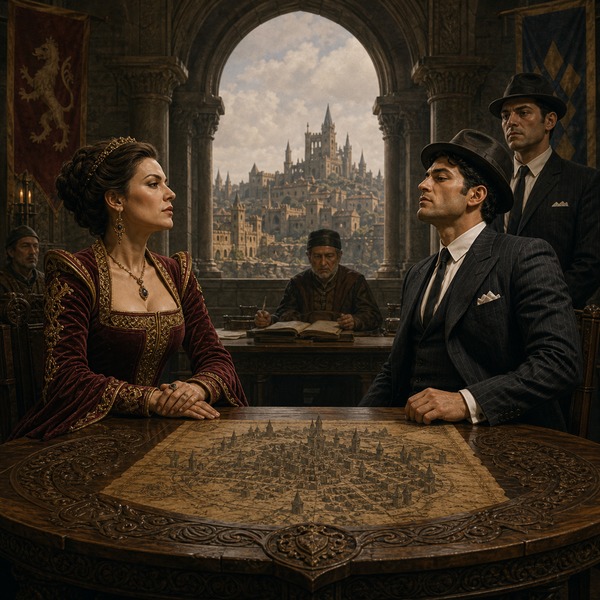
Competitive Pressure
Then Lady Ashworth notices
She controls the guards, the guilds, and every road into the city. Mikey considers compromise a personal insult. She considers him temporary.
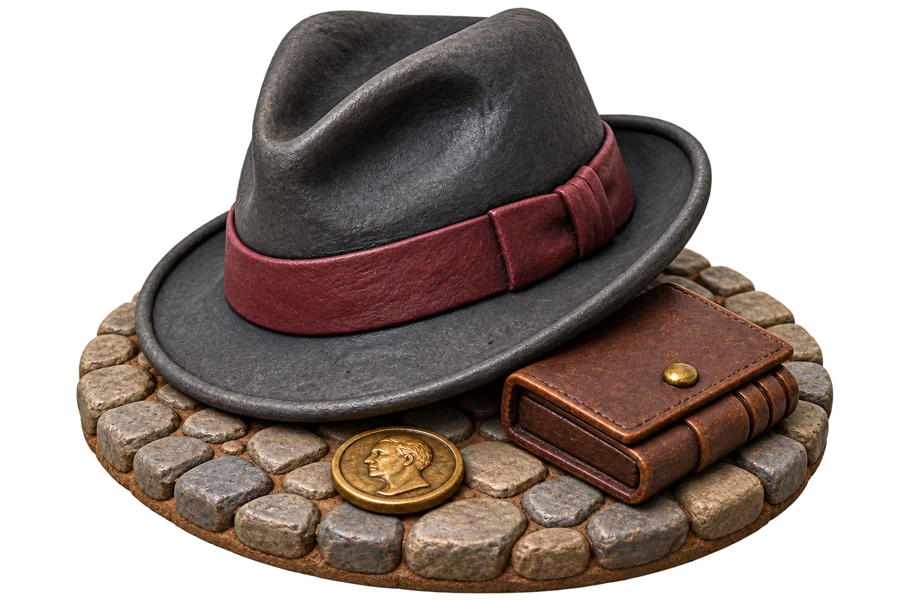
Worth staying for
More from this world
A few things the book's inhabitants left lying around. Fictional documents are labelled; no knowledge of the ending required.
The Red Door's Guide to Selling Pizza in a City That Has Never Heard of Pizza →
A recovered Red Door business memo on tomato shortages, guild classification, medieval delivery logistics, and the business wisdom of letting customers name the product.
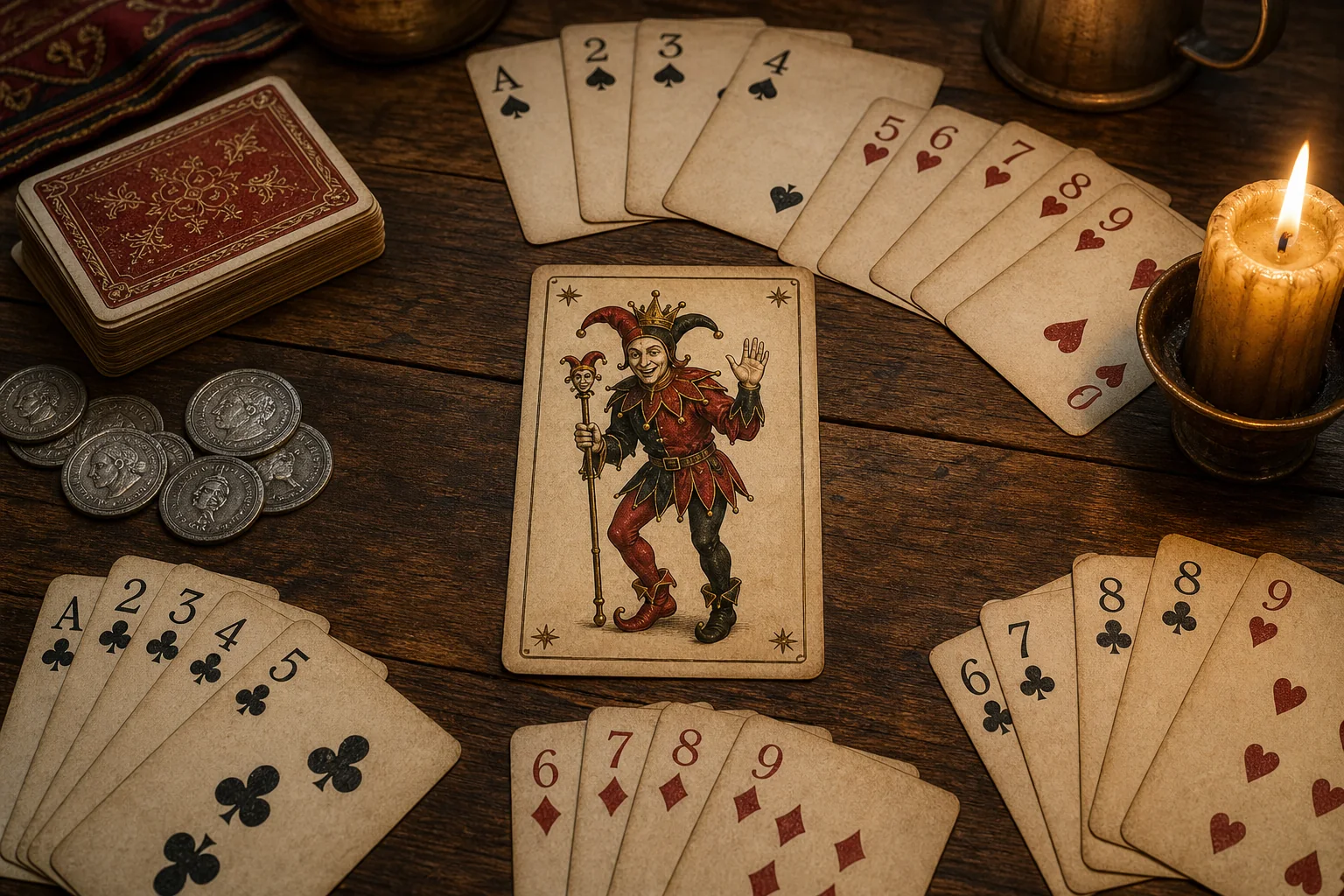
Learn King's Mercy →
The Thornwall card game, adapted for an ordinary deck. Complete rules, freely available.
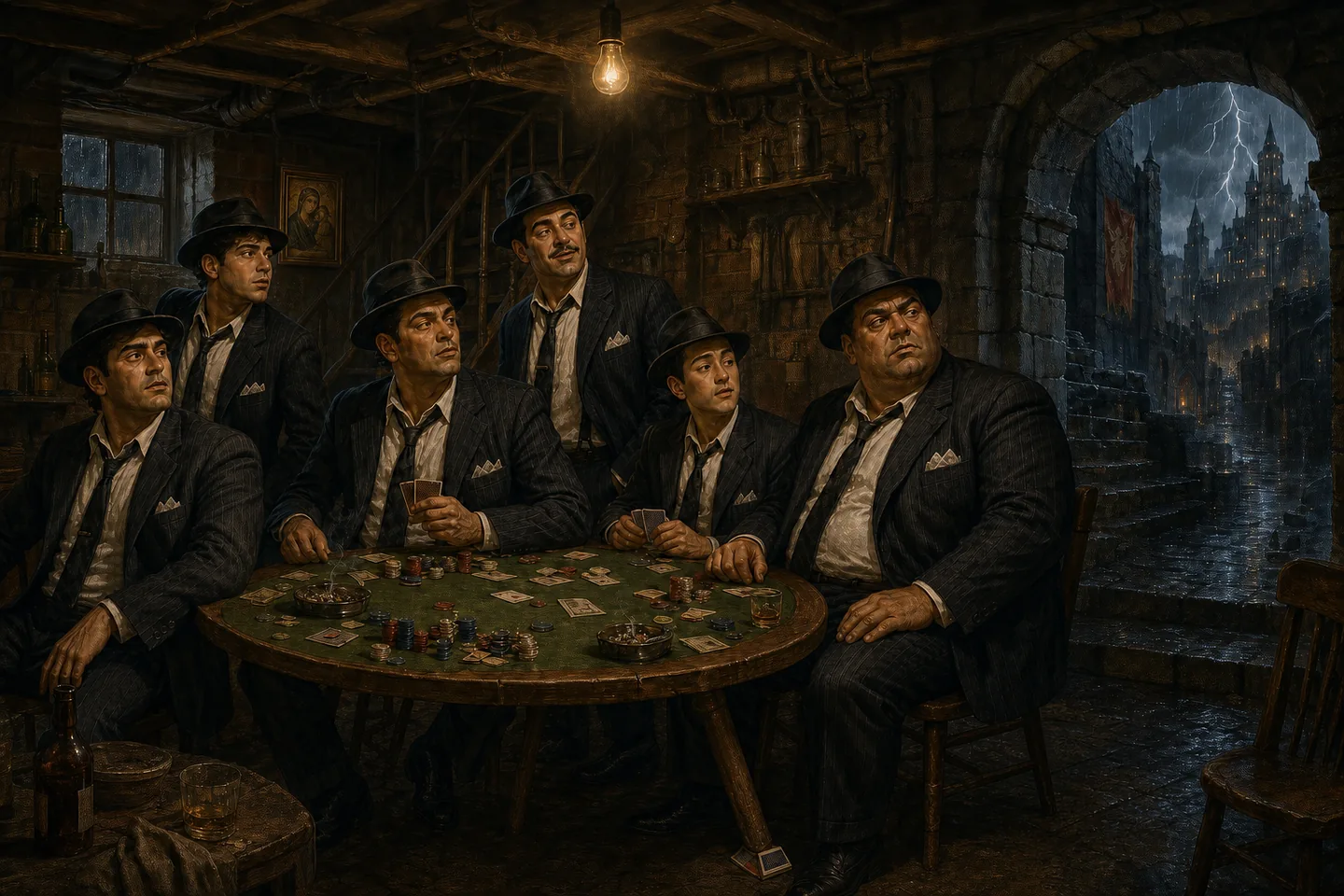
Chapter One · Free to Read
The Basement
Six wiseguys sit down for poker. The stairs lead somewhere they definitely did not before.
Begin the chapter ↓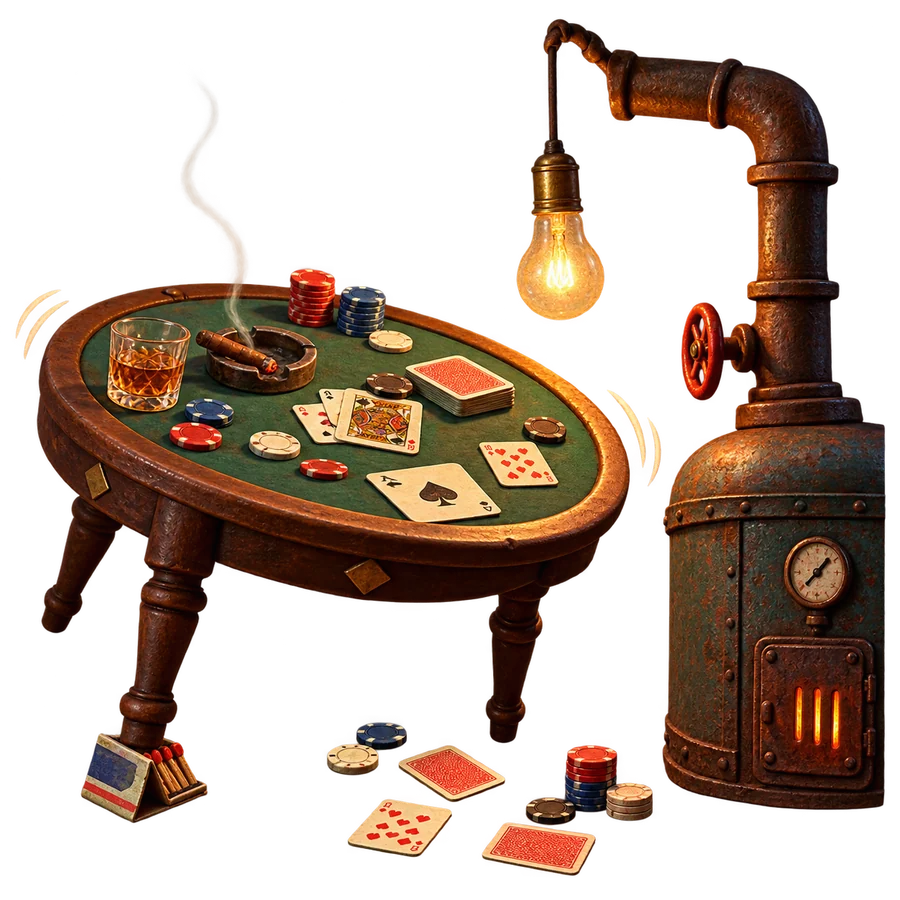
Chapter One · Audio Edition
Listen by the fire
Settle in for the first chapter, then tell me if you would want the whole book in audio.
Original audio: Microsoft Edge TTS · Brian
Description
Six wiseguys. One medieval city. Zero questions asked.
In 1955, six New York mobsters walk down into a Hell’s Kitchen basement to wait out a storm.
They walk up into Thornwall—a walled city of knights, guild halls, herb-sellers who work miracles for a copper, and something with too many legs living under the docks.
They do not panic. They do not look for a way home. They look for the angles.
Inside a month, Mikey Morano and his crew are running a tavern pouring the first cocktails the city has ever tasted, a pizza place the Bakers’ Guild cannot legally classify, a protection operation the merchants are relieved to pay, and a lending business that charges no interest—only favors. The nobility calls it an infestation. The crew calls it a good start.
But Lady Ashworth owns the guards, the guilds, and every trade route in and out. A priest with a tribunal behind him is quietly asking how a man puts an armored knight on the grass from twenty paces. And Tony keeps mentioning that they should maybe go back and check the basement.
Nobody wants to hear about the basement.
The family business
- Portal fantasy with 1950s gangsters who adapt far too quickly
- Competence applied to the completely wrong century
- Cocktails, pizza, protection, favors, and guild politics
- Comedy with strong language and flexible business ethics
A standalone fantasy comedy by Julian Herschel.
Chapter 1 - The Basement
The rain had been hammering the city for six hours straight by the time Mikey Morano decided he was up forty dollars and everyone else could go to hell.
“Read ‘em and weep,” he said, spreading his cards across the table like he’d just brokered peace in the Middle East. “Full house. Kings over sevens.”
Nobody wept.
“That’s the third hand in a row,” Vinny said, not looking up from his notebook where he’d been tracking every pot since nine o’clock. “You’re up forty-two fifty. Which, after what you owe me from the other night, puts you at—”
“Nobody asked you to do math, Vinny.”
“I’m just saying, net—”
“Net. Listen to this guy. Net. We’re playing cards in a basement, not filing taxes.”
The basement belonged to a guy named Carmine DeLuca, who owned the dry cleaner upstairs and didn’t ask questions as long as somebody left a few bucks on the boiler before they left. It was exactly the kind of place you’d expect six guys to play cards on a Thursday night — low ceiling, one bare bulb, a table that wobbled unless you shoved a matchbook under the short leg, and a smell that was either the boiler or something that died near the boiler. Nobody investigated. Some questions you don’t want answers to.
Sal Salerno sat at the far end of the table with his back to the wall, the way he always sat everywhere, and studied his cards like they’d personally offended him. He hadn’t said a word in twenty minutes. This was normal. Sal communicated primarily through silence, occasional violence, and a look. Golden Gloves, 1946.
“Sal, you in or you out?” Mikey said.
Sal looked at his cards. Looked at Mikey. Put two dollars in the pot. Conversation over.
“Eloquent as always,” Paulie Pirelli said from the other end of the table, where he’d been splitting his attention between his cards and a pocket mirror he thought nobody noticed. They were in a basement. There was no one to impress. Paulie didn’t care.
“Paulie, who are you getting pretty for?” Frankie Nardone asked without looking up from the sandwich he was eating. Frankie was always eating. When he wasn’t eating, he was cooking. When he wasn’t cooking, he was talking about cooking. When he wasn’t talking about cooking, it meant something was seriously wrong and someone should call a doctor. “We’re in a basement.”
“A man should always look presentable. My mother taught me that.”
“Your mother also told you you could sing.”
“I CAN sing.”
“Frankie, leave him alone,” Mikey said, dealing the next hand. “Paulie, put the mirror away, you look like a broad.”
“I’m just—”
“You’re just nothing. Cards. Now.”
Tony Castellano, the youngest of the group by a comfortable margin, sat between Sal and Vinny and radiated the eager, uncomplicated joy of a golden retriever that had been allowed to sit at the adult table. He was twenty-three, which in this group made him basically an infant. He’d been brought in because he was Mikey’s cousin’s wife’s nephew or something — nobody could ever remember the exact connection, and at this point it didn’t matter. Tony was around. Tony was always around. He showed up, he did what he was told — usually wrong, but he did it — and he had a quality that was hard to define but impossible to ignore: people just liked the kid. Complete strangers liked Tony. Dogs liked Tony. He once got a free sandwich from a deli because the guy behind the counter said he “looked like he needed it,” which Tony took as a compliment.
He was also, by any measurable standard, not bright.
“Hey Mikey,” Tony said, fanning himself with his cards face-out, giving everyone at the table a full view of his hand with the careless abandon of a man who didn’t understand that poker was a game of secrets. “You hear that?”
“Hear what?”
“The rain. It’s getting bad out there.”
Mikey didn’t look up. “It’s rain, Tony. It falls from the sky. It’s been doing this for millions of years. Are you going to bet or are you going to give me a weather report?”
“I’m just saying, it sounds like it’s really—”
“Tony.”
“Yeah?”
“Bet.”
Tony looked at his cards. He had nothing. A pair of fours and a collection of other numbers that had no business being in the same hand together. He bet two dollars anyway because Tony always bet two dollars regardless of what he was holding, a strategy that was mathematically indefensible and yet somehow worked out for him more often than probability should allow.
Lightning hit something close. The bulb flickered. Everyone looked up except Sal, who continued staring at his cards as if the weather was someone else’s problem, which, in Sal’s worldview, most things were.
“That was close,” Tony said.
“Thank you, Tony. Really. Without you, none of us would’ve known that.”
Vinny pulled his jacket tighter. “Maybe we should call it. I don’t want to drive home in this.”
“You don’t have a car, Vinny.”
“I’m borrowing my cousin’s.”
“Your cousin’s car doesn’t have windshield wipers.”
“It has one.”
“One windshield wiper. In a hurricane.”
“It’s not a hurricane, it’s a—”
“It’s a figure of speech, Vinny. Figure of — you went to college, you should know what a figure of speech is.”
“I went for two semesters.”
“And they didn’t teach you figures of speech in two semesters? What were you doing there?”
“Accounting.”
“Well you got clipped.”
Another crack of lightning, closer this time. The bulb went out completely. Six men sat in perfect darkness for approximately four seconds.
“Nobody move,” Mikey said.
“Why would we move? Where would we go? We’re in a basement.”
“I’m being cautious.”
“You’re being dramatic.”
“Who said that?” Mikey said. “Real brave. Real brave in the dark. We’re gonna discuss that remark when the lights come back on.”
The bulb buzzed, flickered, and came back at about sixty percent of its previous enthusiasm. It cast the room in the kind of light that made everyone look like they were planning a murder, which, to be fair, was not out of character for the group, though tonight’s crimes were limited to Vinny’s card counting and whatever Paulie was doing with that mirror.
Mikey looked from face to face. Every face was suddenly very interested in its cards. He filed the remark under later.
“Alright, forget it,” Mikey said, tossing his cards on the table. “Nobody’s going anywhere in this. We crash here.”
“Here?” Frankie looked around the basement like he’d been asked to sleep in a sewer. “I’m not sleeping in here. This place smells like something died.”
“Something probably did die. This is Carmine’s basement. You know what Carmine’s like.”
“I’m not sleeping next to a dead thing, Mikey.”
“You don’t know there’s a dead thing. I said probably.”
“Probably is enough!”
“Frankie, where are you going to go? Outside? In that?” Another crack of thunder, as if the sky itself was weighing in on the argument. “Lay down, shut up, and in the morning we walk out of here like civilized people.”
Frankie grumbled something about the smell, the floor, the lack of pillows, the temperature, the general decline of his quality of life, and the fact that his mother would be worried — though his mother had stopped worrying about Frankie around the time he turned fifteen and started coming home at four in the morning smelling like garlic and other people’s cigarettes.
They settled in the way men settle into uncomfortable situations — badly, and with a lot of complaining. Sal leaned against the wall, closed his eyes, and was asleep in thirty seconds, because Sal could sleep anywhere at any time, a skill he’d picked up during a period of his life he didn’t talk about and nobody asked about. Vinny curled up in the corner with his jacket as a pillow and his notebook clutched to his chest like a teddy bear. Paulie found the least dirty spot on the floor, laid his jacket down, and slept on top of it to avoid wrinkling his shirt, a gesture of vanity so profound it almost qualified as art. Tony fell asleep mid-sentence, which was fitting, because most of Tony’s sentences didn’t have endings anyway.
Frankie complained for another eleven minutes by Vinny’s estimate, then fell asleep mid-complaint, which Mikey appreciated because it meant the complaint also didn’t have an ending.
Mikey was the last one awake. He sat at the table, listening to the rain beat against the small window near the ceiling — the only window in the basement, set high in the wall, level with the sidewalk outside. Through it he could see nothing but water and the occasional flash of lightning turning the world white.
He lit a cigarette and played solitaire by himself until the cigarette was done, then he put his head on the table and closed his eyes.
The storm raged.
Morning came the way morning usually comes to men sleeping on concrete — violently and without mercy. Mikey’s neck had developed a crick that felt like someone had installed a hinge in the wrong place. Frankie was already up, complaining about his back, which meant the world was functioning as designed. Vinny was doing math in his notebook. Paulie was fixing his hair. Sal was standing by the stairs, already waiting, already awake, possibly never having been fully asleep despite all evidence to the contrary.
Tony was lying on the floor with his mouth open, dead to the world, until Sal kicked his shoe.
“Wha—”
“We’re leaving.”
“Already?”
“It’s morning, Tony.”
They gathered their things — cards, cash, Vinny’s notebook, Paulie’s mirror, Frankie’s leftover sandwich wrapped in a napkin — and headed up the stairs single file, Sal first because Sal was always first through any door, a habit born from a lifetime of walking into rooms where the first person through might catch something other than a greeting.
Mikey came last, pausing to leave eight dollars on the boiler for Carmine. He took one look around the basement — the bare bulb, the wobbly table, the matchbook under the leg — and followed the others up.
The door at the top of the stairs opened to the outside. Normally, this meant the alley behind Carmine’s dry cleaner, which smelled like chemicals and old garbage and connected to Bleecker Street, which smelled like everything else.
Sal pushed the door open.
What was on the other side was not the alley behind Carmine’s dry cleaner.
The air hit them first. Not city air. Not car exhaust and hot dog carts and the collective output of eight million people living on top of each other. This air was clean. Aggressively clean. The kind of clean that felt wrong, like something was missing from it — namely, pollution.
Then the ground. Not concrete. Not asphalt. Cobblestone. Actual, honest-to-god cobblestone, the kind you see in old paintings of places that don’t exist anymore.
Then the buildings. Stone. Timber frames. Thatched roofs. Narrow windows. No glass in some of them, just wooden shutters hanging open. Nothing above three stories. No fire escapes. No neon. No signs advertising anything recognizable.
Then a horse walked by.
Not a police horse. Not a horse pulling one of those tourist carriages in Central Park. Just a horse. Walking by. On the street. Like it had somewhere to be.
Six men stood in a doorway wearing rumpled 1950s suits, smelling like Carmine’s basement, and stared at a world that had absolutely no business being on the other side of that door.
Nobody spoke for a long time. Long enough that the silence itself started to become uncomfortable, which in this group was approximately nine seconds.
Tony broke it.
”…Mikey, where’s the car?”
Mikey didn’t answer. He was looking at the street, the buildings, the horse, a woman walking past in a long dress carrying a basket of something on her hip, a man in what appeared to be actual medieval clothing pushing a wooden cart, and — in the distance — what looked very much like a castle tower rising above the rooftops.
“Mikey.”
“I heard you, Tony.”
“Where’s the car?”
“I don’t know where the car is.”
“Well… where are we?”
Mikey looked left. Mikey looked right. A second horse walked by. Somewhere in the distance, a bell was ringing. Not a church bell from Our Lady of Pompeii on Carmine Street. A different kind of bell. An older kind.
“Where does it look like we are?” Mikey said.
Frankie stepped out into the street, looked both directions, looked up at the sky — which was clear and blue and completely devoid of buildings taller than a few stories — and looked back at Mikey.
“It looks like we’re in a fucking castle, Mikey.”
“Then there’s your answer.”
And Mikey Morano stepped out into the street, straightened his tie, and started walking like he knew exactly where he was going, which he absolutely did not.
The others followed. Because that’s what they did. Mikey walked, they followed, and somebody usually got yelled at along the way.